
Mercat de la Boquerìa (Mercat de Sant Josep)
The most famous, most beautiful, biggest market in Barcelona, but typical
Nowhere else in Barcelona is a tourist attraction so closely associated with the daily life of the locals, like the Mercat de la Boquerìa, right on the Rambla.
Visiting the market and Old Town
In Mercat de la Boquerìa all the senses will be appealed to. Some people market their product prices loudly; in every corner you can experience new smells, familiar as exotic. The colourful presentation of the goods seem to be like the famous still-life painter. The roundabout in the middle of the market, with the variety of often still living marine animals in Aquàrium competition.
Nowhere you can enjoy a meal as fresh as here, on many boothes you can not only taste the products but also have a lunch.
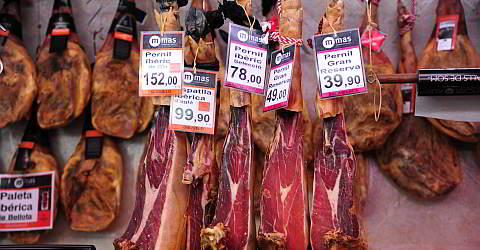
In the Mercat de Sant Josep, as the Mercat de la Boquerìa is named actually, you can find almost everything the culinary heart desires: sweets, honey, cheese, refined oils, olives, local and exotic fruit and vegetables, meat, ham, fish, seafood. All fresh and a huge selection.
This diversity and the experience to get irritated in all senses make the Mercat de la Boquerìa a very special experience in Barcelona. If you are in Barcelona to stay in an apartment, you can very well compare the prices and shopping. We also have the right recipes at hand.
Pla de l'Os
Above the main entrance to the Mercat de la Boquerìa is on the Rambla the Pla de l'Os, the Bearsplace, as he called for the jugglers, who let their bears dance here. In the square, which was not a prominent place, but a small part of the Rambla, is a mosaic of Joan Miró. This has created in 1976. On the opposite side you can see a former business umbrella, the Casa Bruno Quadros. That alone is something bizarre, but the facade is interesting, decorated with copper screens and a dragon.
The history of the marketplace La Boquerìa
The market activity in the city began at the beginning of the 13th Century as a commercial market. The Ramblas were always stronger than walk frequently. A situation with a lot of through traffic from locals and foreigners was of course ideal for a market and trading centre. The former suburban location also offered ideal conditions, as within the city walls no room for a larger market. On the Pla de la Boquerìa was a city gate.
In the 18th Century, several markets were getting together to the market in the Rambla de Sant Josep. In 1826 Marques Campo adopted the Sagrada Market Rules for the first time of the Mercat de Boquerìa. On 18 October 1827 then the current market was founded. In 1835 has begun to tear down the district. A new district, then the largest, is built. The city administration decided in 1836 the establishment of a covered market hall. In 1840 was the foundation and 1848 saw the completion of an administrative building and the veterinary office. In 1861 the fruit and vegetable dealer received the right, also to sell there their goods. Until then, a privilege of meat dealer ( "Boquerìa" means butcher). Also flowers were henceforth exclusively on this part of the Rambla sold. Some merchants issued a flower on the purchases.
In 1869, the building beyond the Carrer de Jerusalem demolished to make place for the market to the present size of 13,600 square meters.
In 1914, inaugurated the metal roof, which now is the sun and weather protection. From that time the market will also become a tourist attraction.
Other markets in Barcelona
The Mercat de la Boquerìa is not the only market in Barcelona. Many markets in the other parts of the city are also very beautiful and worth seeing:
- Mercat de Sant Antoni. Steel market in a hall, fresh produce, but also second-hand clothes and books will be on Sunday also offered (west of the district Ravals Subway: L2, Sant Antoni)
- Mercat de Santa Caterina. With a striking, in 2005 hightened roof. The prices are cheaper than in the Mercat de la Boquerìa (east of the Gothic district, about 300 metres from the cathedral, Avinguda de Francesc Cambó; Subway L4, Jaume I)
- Mercat de La Sagrada Familia. A small market hall near the Church (Carrer de Padilla, Subway: L2, L5, Sagrada Familia)
- Mercat de Ninot. Market in the Eixample, almost as beautiful as the Mercat de Sant Josep (Carrer de Mallorca, Subway: L5, Hospital Clínic)
- Mercat de la Concepció (Carrer de Valencia, Subway L4, Girona).
- Mercat de la Llibertat. Plaza de la Llibertat, Gràcia FGC),
Mercat de l'Abaceria Central (Travessera Gràcia 186, Subway: L3, Fontana)
Here you can book
- Practical cooking lesson and visit the Boqueria market
Important information

Surroundings
Find Hotels nearby
Address
Rambla St. Josep
www.boqueria.info
Arrival
Metro: Liceu (L3)
Parking nearby
Opening times
Mo.-Sa. 6-20.00
Many booths open on 8.00 and close at 19.00.
Admission
Free Admission.
Tips for the visit of the Mercat de la Boqueria
It will be distracted here by many impressions very quickly. Be cereful a little on your valuables and you can enjoy the visit.


Book your accommodation in Barcelona here! All categories.
1-5*-hotel rooms, apartments, hostels.